
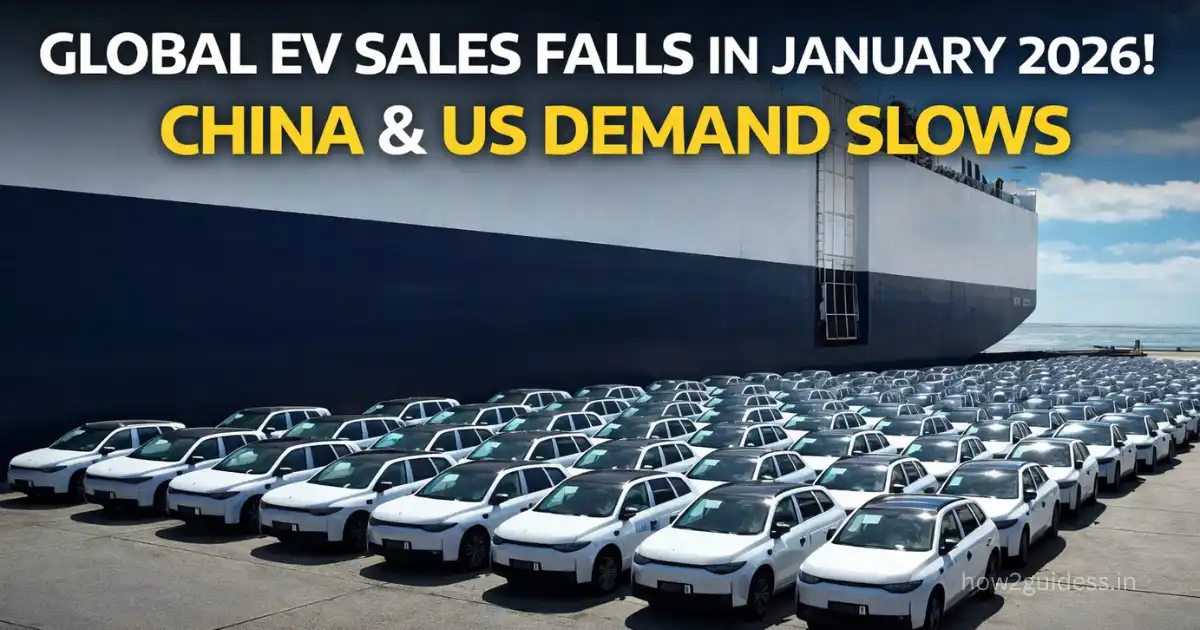
Global EV Sales started 2026 with an unexpected slowdown. Registrations of battery-electric and plug-in hybrid vehicles fell by about 3 percent year-on-year in January to nearly 1.2 million units, according to data compiled by Benchmark Mineral Intelligence and reported by Reuters.
While a single month does not define a long-term trend, the decline is notable because it comes after several years of near-continuous growth in EV adoption across major markets. The January numbers highlight how closely EV demand remains tied to policy support, incentives and broader economic signals.
Also Read: Tata Motors January 2026 Sales Analysis: Nexon, Punch, Sierra Drive Growth
China: Policy changes weigh heavily
China, the world’s largest EV market, was the biggest drag on Global EV Sales. Registrations dropped by roughly 20 percent compared with the same month last year, slipping to under 600,000 units. This marked the country’s weakest monthly EV performance in nearly two years.
The decline followed recent changes in government policy, including reduced subsidies and the introduction of a new purchase tax that has raised upfront costs for buyers. These measures appear to have disrupted demand that was previously supported by generous incentives and regulatory mandates.
For manufacturers operating in China, the slowdown underscores how sensitive EV demand can be to even modest policy adjustments. It also suggests that organic, incentive-free growth is still a work in progress in many EV segments, particularly outside premium urban markets.
North America sees a sharper pullback

North America recorded an even steeper decline. EV registrations in the region fell by around 33 percent year-on-year in January, making it the weakest monthly performance since early 2022. In the United States, the slowdown coincided with changes to federal and state-level incentives that had previously lowered effective purchase prices.
The pullback suggests that a significant portion of recent EV demand in the US was incentive-led rather than purely consumer-driven. As subsidies ease, buyers appear more hesitant, especially in mass-market segments where price sensitivity is high and charging infrastructure concerns persist.
For global automakers with heavy exposure to North America, this has already translated into financial pressure. According to Reuters, manufacturers have booked close to $55 billion in writedowns over the past year as they reassess EV investments and scale-back overly optimistic volume projections.
Europe grows, but momentum slows
Europe was the only major region to post growth in January, with EV registrations rising by about 24 percent to just over 320,000 units. However, this was the slowest pace of growth in roughly a year, indicating that even Europe’s relatively mature EV markets are beginning to cool.
Several European countries have also rolled back or recalibrated incentives, shifting focus toward longer-term infrastructure development and fiscal discipline. As a result, while adoption continues, the acceleration seen in earlier phases of the EV transition is moderating.
This trend suggests Europe may be entering a more stable but slower growth phase, where EVs expand steadily rather than rapidly. For manufacturers, this means sharper competition, pricing pressure and a stronger emphasis on product differentiation.
Hybrids regain relevance globally
One of the more important undercurrents in the January data is the renewed strength of hybrid vehicles. As full Global EV Sales lose some momentum, hybrids are increasingly seen by consumers as a practical middle ground.
Lower upfront costs, familiar refuelling patterns and reduced dependence on charging infrastructure make hybrids attractive, particularly in regions where public charging remains inconsistent. This shift indicates that many buyers still value flexibility over a full transition to battery-electric mobility.
For automakers, this reinforces the importance of maintaining a diversified powertrain strategy rather than focusing exclusively on EVs.
Emerging markets offer a counterbalance

Outside China, North America and Europe, EV demand is telling a very different story. Registrations in the rest of the world jumped by about 92 percent year-on-year to just under 190,000 units, a record high.
Growth was driven by continued incentives in markets such as Thailand and rising adoption in countries including South Korea and Brazil. While volumes remain smaller than in established EV markets, the pace of growth highlights where future expansion opportunities may lie.
Benchmark Mineral Intelligence notes that Chinese EV manufacturers are increasingly targeting these regions through exports, a trend expected to continue through 2026 as domestic demand softens.
What this means for India
Although India is not a major contributor to global EV volumes yet, the global slowdown has indirect implications. A cooling of demand in China and the US could intensify competition in export-focused markets, potentially benefiting India through more aggressive pricing or faster technology transfer.
At the same time, the global shift toward hybrids aligns with India’s current market reality, where infrastructure constraints and cost sensitivity favour transitional technologies. For policymakers and manufacturers, the January data serves as a reminder that sustained EV adoption requires consistent policy signals and long-term planning.
Conclusion- Global EV Sales
The 3 percent dip in global EV sales in January 2026 does not signal a reversal of the electric mobility transition, but it does highlight its fragility. Policy changes, subsidy reductions and economic pressures continue to shape buyer behaviour across regions.
As automakers adjust strategies and consumers reassess priorities, the next phase of EV growth is likely to be more measured, more regional and more dependent on fundamentals rather than incentives alone.
Disclaimer: This article is based on publicly available industry data and reports available at the time of writing. Market trends and interpretations may evolve as new information emerges.
Also Read: Royal Enfield Production Capacity to Reach 20 Lakh Units After Rs 958 Crore Expansion

Raj Prajapati is a senior automobile content writer at How2Guidess.in with over 3 years of experience in auto news, vehicle launches, comparisons, and EV updates. With a background in Computer Science & Engineering, he focuses on research-based, clear, and reader-friendly automobile content.